

Meeting Cora
Part 3 - Three Adaptations of James M. Cain's The Postman Always Rings Twice

This series traces the afterlives of James M. Cain’s The Postman Always Rings Twice through three key adaptations: Le Dernier tournant (Chenal, 1939), Ossessione (Visconti, 1943), and The Postman Always Rings Twice (Garnett, 1946). Each post continues a comparative analysis of the films to uncover what each adaptation reveals by way of its differences.


Then I saw her. She had been out back, in the kitchen, but she came in to gather up my dishes. Except for the shape, she really wasn't any raving beauty, but she had a sulky look to her, and her lips stuck out in a way that made me want to mash them in for her.
“Meet my wife.”
Cain. Postman. Chapter 1.
After Frank first sees Cora, who impresses him more with her attitude than her looks, the narrative moves briskly through a cascade of moments that signal both the casual ease and the underlying tension of his new situation. Cain doesn’t describe her as beautiful. She’s sullen, with lips that make Frank want to “mash them in.” That’s all it takes. He walks out, then doubles back under flimsy pretext. By the end of the page, he’s shaken Nick’s hand, scoped the kitchen, and started voyeuristically watching her.
By the start of the next chapter, he flirts, casually but provocatively, with a racially charged comment that frames Cora as possibly Mexican. Her rebuttal is sharp. She asserts her whiteness, her Midwestern roots, and her independence all at once, staking out her independence even as the dynamic between them veers toward seduction.
Cain moves fast here, but not aimlessly. The novel’s whole logic is built into this sequence: from glance to desire to verbal, almost physical sparring, it’s all sketched in a few clean turns. With the speed characteristic of 30’s pulp writers, roles are assumed, identities tested, attraction is laid bare and the psychological groundwork is set for the rest to follow.
Le Dernier Tournant
Fernand Gravey is introduced to Cora (Corrine Luchaire), she is wearing a long frumpy kitchen smock and a turtleneck sweater. She’s beautiful (of course! what 30s French star wasn’t?) but she’s far from dolled-up. Still, Gravey gives her a once-over, lips still wet from the wine. When he agrees to stay, he does it with a raised eyebrow and a second glance.


With her husband constantly pawing at her and calling her his petite colombe, this version of Cora resembles a meek domestic more than a femme fatale.1
Three weeks pass, and Simon is pleased with Gravey’s work - as well as the privilege of staying in bed with his wife knowing someone else is answering the gas-calls. In the first shot of Gravey and Luchaire together (left), the framing says everything: she’s a blurry figure in the distance, far from and uninterested in what the new hire is up to. When Simon and a visiting trucker examine Gravey’s new sign design, she enters the scene as a barmaid, bringing glasses and wine. Again: servile, detached, and outside the circle.


As soon as the trucker leaves, Gravey launches his scheme; but not before a quick side glance at Luchaire, alerting us to his motivation. She stands at the sink, drying glasses.
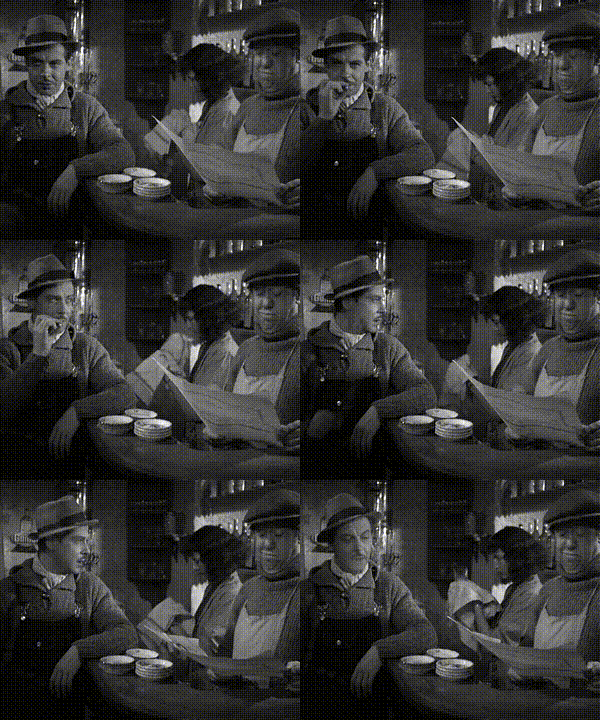
He begins to pitch to Simon the final stage of his plan to be left alone with Luchaire, a scheme he’s clearly been mulling for a while. Luchaire freezes. Her gaze fixes on him. What he’s doing has all of a sudden become clear. Gravey sells the idea. Simon is on the hook. Gravey bounds down the stairs to fetch the car.
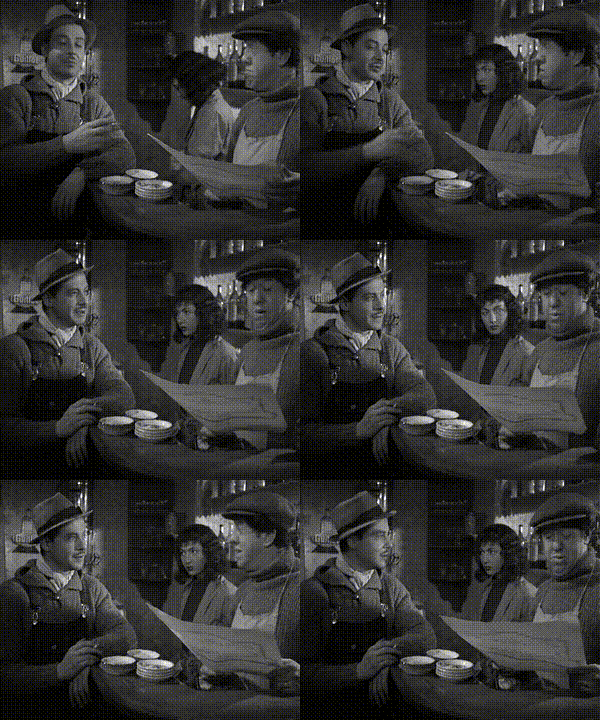
Like Cain, Chenal compresses time and tension into two swift scenes. Three weeks of glances, silence, and planning condense into one visual pairing and a few lines of dialogue. At this point, we’ll eventually learn Luchaire is just as motivated as Gravey -if not more so - but for now, their alliance appears to be his invention alone.
Ossessione
Before stepping into the trattoria, Girotti (Visconti’s Frank, or Gino) searches his pockets and pulls out a couple coins. He walks in, steps up to the counter and calls to be served while tapping the coin on the counter. Getting no response, he walks to the kitchen where he hears Calamai singing. Bracket the erotic intensity of their first encounter, his first words are “Si mangia qui?” while he flips one of his coins.
Visconti’s deviation from the novel is pointed. It may seem inconsequential, but as far as the script diverging from the novel, this is significant. As we noted, in both the novel and the Chenal, Frank resorts to subterfuge to scam a meal. This is a key aspect of the build up of the character. I note it here because it’s on this note that a key aspect of the Calamai/Giovanna depiction of Cora depends.
While Luchaire is first presented as an innocent victim, Visconti’s Cora, or Giovanna, played by Clara Calamai, is anything but.2 She’s first presented as a kind of siren, enchanting her victim, but also genuinely consumed by her desire for the man she aims to seduce.3
When Girotti walks into the kitchen, we haven’t yet seen his face. When we first see Calamai, we hear her sing, then only see her legs dangling from the side of the table. Just like our delayed introduction to Girotti’s face, Visconti builds up this meeting to set-up the famed shot-reverse-shot.4


The double-take, the cocking of her head, the fact that Girotti has to ask “Can we eat here” and then, because she is mesmerized, he has to repeat “I asked you if we can eat here?”, efficiently establishes the nature of this doomed relationship.
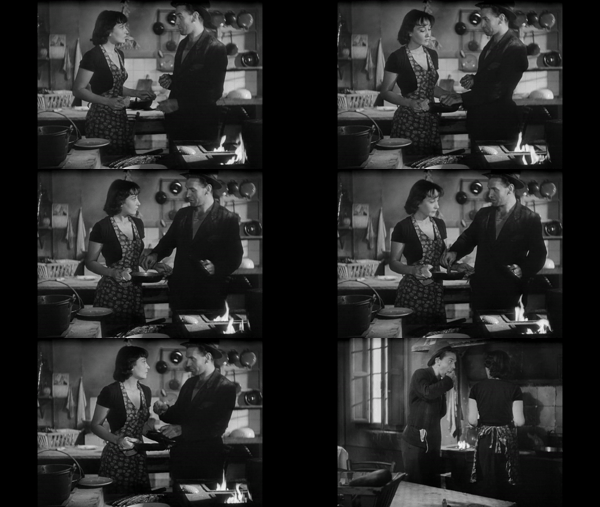
Girotti saunters into the kitchen, and making sure his appearance doesn’t lead her to make the same assumptions as the men outside, says “I pay” while still flipping his coin. Throughout their initial conversation, she tells him to go out to the dining room - knowing her husband will return momentarily - but her actions and body language betray her. He makes himself at home and she allows him to do so, allowing him to linger, to come close to her. He picks meat out of the frying pan and he makes a pass at her even after she’s told him that the pot bellied man outside is her husband. Even as she takes away the frying pan he was helping himself to, she can’t help but be submissive to him. The symbolism of this little interaction (below) says it all: held waist high, he takes the lid off her pot and helps himself to what’s inside.
After her husband walks in, inventing a story about stolen chickens, Bragana tells Girotti to get out and berates his wife for letting him in. Girotti is content to leave this beautiful woman with a smile an amiable nod of his head. Calamai, on the other hand, palms the two coins and accuses her husband of talking so much that he let Girotti go without paying.


Ossessione is the only version of this story that builds this key foundational scene on the woman’s desire and not the husband’s. The idea of giving money to this transient worker further solidifies the images of his independence - he’s not asking for a handout - which further exemplifies Calamai’s role as a siren-like seductress.
The Postman Always Rings Twice
Tay Garnett’s adaptation is the most widely known of the adaptations. Lana Turner as Cora has been called a femme fatale so many times this performance can stand as the American wartime film noir definition of the term.5 Her appearance out-of-nowhere is also well known.
Nick (Cecil Kellaway) goes to serve someone at the gas station and leaves Garfield in the diner alone. All of a sudden, a lipstick tube rolls over to where he is sitting. Maybe it’s just me, but the countless times I’ve seen this film, only now that I’m looking at it analytically do I realize that she must have tossed it there intentionally to get his attention and play the game she plays. The Production Code keeps things coded, but the dynamics are unmistakable. It’s not just a haughty attitude. It’s a game she’s likely played before: initiate the chase, then pull back to see how the man responds. Except Garfield doesn’t fall for it, at least not entirely.


First, appreciate the distance the camera has to travel to get back to Turner’s legs! There’s no way that accidentally rolled all that way. Next, like with Visconti’s shot-reverse-shot identifying with Calamai’s gaze, we get a more subtle but still clear reaction by Garfield. He lets out a small gasp - an involuntary intake of breath - before the camera reveals the object of his gaze. She watches, expecting him to walk it back to her, but instead, he just stretches out his hand, forcing her to cover the distance.


After this initial scene, Turner suggests to her husband to let Garfield go with a week’s pay. Kellaway doesn’t ask her why and, from the perspective of hindsight, we might imagine that she was sexually bothered by her arousal and inability to instantly dominate Garfield. But this may be too hasty. As soon as she leaves her husband, she goes into the diner and sees Garfield smoking a cigarette, reading a newspaper with his feet on the table. They have an exchange where she puts him to work that ends with her saying “I wanna make something of this place…” We know that this is one of the main difficulties when, in the novel, Frank and Cora get together: he wants his freedom, her ambition drives her to stay put. We might take her reaction to Garfield after he kisses her for the first time as a confirmation of her principal interest at this point in the film. Her remark that she wants to make something of the place and withdrawal in annoyance or contempt points less to romance than to her larger ambitions.
Like in Chenal’s version, time passes - “a couple weeks” - where she ignores him. In the voice over, while Garfield smokes a cigarette outside in a storm, he tells us that “I disturbed her, I knew she hated me for that worst of all.” The storm then causes the “Twin Oaks” sign to fall. Reading Turner as ambitious rather than sexually predatory, we can connect Garfield’s scheme to fix the sign with Cora’s request to paint the chairs. Unlike the other Coras, the motivation that defines this femme fatale is not insurance money (Stanwyck, Double Indemnity), nor disgust of her husband’s advances (Luchaire, Le Dernier tournant), nor animal lust (Calamai, Ossessione), but a more palatable ambition: the all-American dream of self-made improvement, upward mobility, rendered dangerous only by circumstance.
Before Chenal, Jean Renoir had begun pre-production on an adaptation of The Postman Always Rings Twice, with plans to cast Jean Gabin and Viviane Romance. When Chenal inherited the script, he still hoped that Romance would play Cora. But he had just directed her in La Maison du Maltais (1938), where she moved from innocent waif to a domineering femme fatale in the tradition of Louise Brooks, Brigitte Helm, and Pola Negri. Neither Romance nor Chenal wanted to repeat that role. She passed on the film, and Chenal cast and directed his new Cora in the opposite direction.
In a 1981 interview, Chenal admitted this was a mistake:
J'ai horreur du cliché, de l'idée reçue, et j'ai raté un film, Le Dernier Tournant, à cause de ça. J'avais déjà utilisé Viviane Romance en femme fatale, mais je trouvais cela trop évident. Je me disais : des tas d'hommes sont fous de filles en apparence imbaisables. Alors j'ai choisi Corinne Luchaire, une fille qui dans la vie faisait des ravages, en un contraste curieux avec son physique. C'est là un soi-disant miscast que personne ne m'a pardonné… Je trouve que le film est raté, j'aurais dû prendre Viviane Romance comme dans La Maison du Maltais.
Pierre Chenal, interview with Jacques Fieschi, Cinématographe no. 70 (1981)
Femme fatales appear throughout the so-called poetic realist films of the late 1930s: Mireille Balin in Pépé le Moko (1937), Simone Simon in La Bête humaine (1938), Arletty in Le Jour se lève (1939). Chenal wished Romance, twenty-seven at the time, had agreed to reprise the type. Instead, the eighteen-year-old Corinne Luchaire took the part.
In her memoir, she recalls the experience of playing opposite Michel Simon:
Dans Dernier tournant, Michel Simon était mon mari. En tant que mari, il avait naturellement droit, bien entendu sous les sunlights, à quelques familiarités. Mais Michel Simon joue ses compositions réalistes avec une conscience, mettons exagérée. J'étais sa femme. D'accord. Il devait me prendre par la taille. C'était naturel. Mais Michel Simon trouva que ce geste était bien banal, et il n’hésita point à me saisir avec une certaine violence et un faciès vraiment lubrique, à un certain endroit de ma personne qui n’aurait dû jouer aucun rôle dans un film convenable.
Corrine Luchaire, Ma Vie privée (1963)
Add to this Chenal’s claim that “Simon revenait du bordel pour jouer son rôle vers six heures du soir…” and we are left not with a femme fatale but with a pathetic figure, someone we feel sympathy for, not fear and desire. That tone is echoed in her dialogue:
Tu sais ce que ça veut dire, être graisseux, Frank? ... Non, non, c'est impossible. Un homme ne peut pas savoir ce que c'est pour une femme ; être tout le temps avec quelqu'un de gras, quelqu'un qui vous soulève le cœur dès qu'il vous touche. Frank j’en peux plus…
Cora, Le Dernier tournant
But she doesn’t fit any of the standard femme fatale molds either. Clara Calamai was a last-minute replacement for the role of Giovanna after Anna Magnani became pregnant and had to withdraw. Before Ossessione, Calamai was already established as one of Italy's most sophisticated leading actresses, known for glamorous roles in historical dramas and melodramas. She typically appeared with bleached blonde hair and had built her reputation in nationalistic costume films like Pietro Micca (1938) and Ettore Fieramosca (1938). Her most notable previous role was as a courtesan in Blasetti's La cena delle beffe (1942), which featured a controversial (albeit very brief) nude scene that made her body a symbol of both nationalist fantasy and sexual projection for Italian audiences.
Calamai reportedly objected to her visual transformation in Ossessione. Aldo Tonti, the film’s director of photography, recalled:
When she saw herself, the first day, she started crying, fled from the projection, and said: ‘I’m not finishing this film. Enough, enough, I didn't think I would be treated this way.’ And she wanted to abandon the film.
Quoted in Elena Past “The Dying Diva: Violent Ends for Clara Calamai in Ossessione and Profondo Rosso” (2008). Forum Italicum, 42(2)
Giovanna has often been described as a siren or Circe figure, first luring Gino into her kitchen by singing “Fiorin fiorello, amore é bello vicino a te.” The erotic charge of the moment is heightened by a slow zoom into Gino’s face as he listens. Gino enters without invitation, drawn by her voice. As Nowell-Smith notes, this can be read as an allusion to Circe in The Divine Comedy, who, like her Homeric counterpart, lures wanderers with song.
(See Jones [2018] and Nowell-Smith’s commentary.)
Yet, this mythic framing is immediately complicated by Calamai’s performance and the scene structure. Girotti is no naïf, and Calamai’s look (especially the double-take when she finally sees him, and her likening him to a horse when he takes his shirt off) registers shock, interest and desire. The camera’s attention to his body, not hers, signals an inversion: he is the object and she is the gazing subject.
Calamai’s song may establish her as a siren figure, but it is her visible desire that transforms the scene, captured in her stillness, her head tilt, and the need to be asked twice whether one can eat there. isconti builds the erotic energy not on exposure of the female body but on her reaction to Gino’s. As Catherine O’Rawe (Fatality in Italian Neorealist Cinema, 2010) has argued, the double-take reverses the conventional dynamic of cinematic desire, giving star treatment to the male body.
This early moment in Ossessione thus becomes a counterexample to Mulvey’s “Visual Pleasure” thesis. Here, the gaze aligns not with male scopophilia but with female desire made visible and central.
Interestingly - almost unbelievably - she too was apparently not the first candidate to star in the Cain adaptation. According to Hollywood gossip columnist Hedda Hopper,
Billy Wilder … is deep in the throes of trying to buy James Cain’s Postman from Metro. If he gets it - and he will - Barbara Stanwyck says she'll make it with him.
Hedda Hopper. “Looking at Hollywood” Los Angeles Times 3.8.1944.
Like Viviane Romance and Anna Magnani, a Barbara Stanwyck performance would have transformed the role of Cora into something completely different - to say nothing about Billy Wilder’s direction of another Cain novel.